In the town where I spent the first years of my life, the world was no more than three blocks long and three blocks wide. From our corner house, you could glimpse its boundaries: a towering mountain at the end of one street; at the other, a tall hedge threaded with fig trees and a ruined timber cottage. Yet places just beyond these edges lent the town mystery and depth, expanding its imagined dimensions—the long coastline shaped by warm summer winds, the abandoned railway line, the trickling creek, and the houses of my two aunts. One had a goldfish pond and palm trees; the other unfolded as a cascade of rooms and terraces, a space whose connections and proportions remain elusive in memory.
Every path seemed to begin and end within that three-by-three block world, a self-contained universe with me at its centre. Halfway to the coast stood a small white church, where my grandmother led me during Easter week. We approached along the eucalyptus-lined avenue that stitched the Frankish castle at one end of town to the seaport at the other, passing her house along the way. The church stood alone, hidden from our view, in what I once thought was pastoral land—though my father later called it half pastoral, half industrial. Built in the early twentieth century, it was a votive offering to mark the night a factory on that very site was spared from fire. During Easter rites, the church brimmed with worshippers, so crowded it seemed a miracle the candle-laden stands never toppled and set the place ablaze. If I were to draw a map of that small world, it would defy the neatness of a grid: a patchwork of gaps and empty spaces, of invisible boundaries and streets that never quite connect.
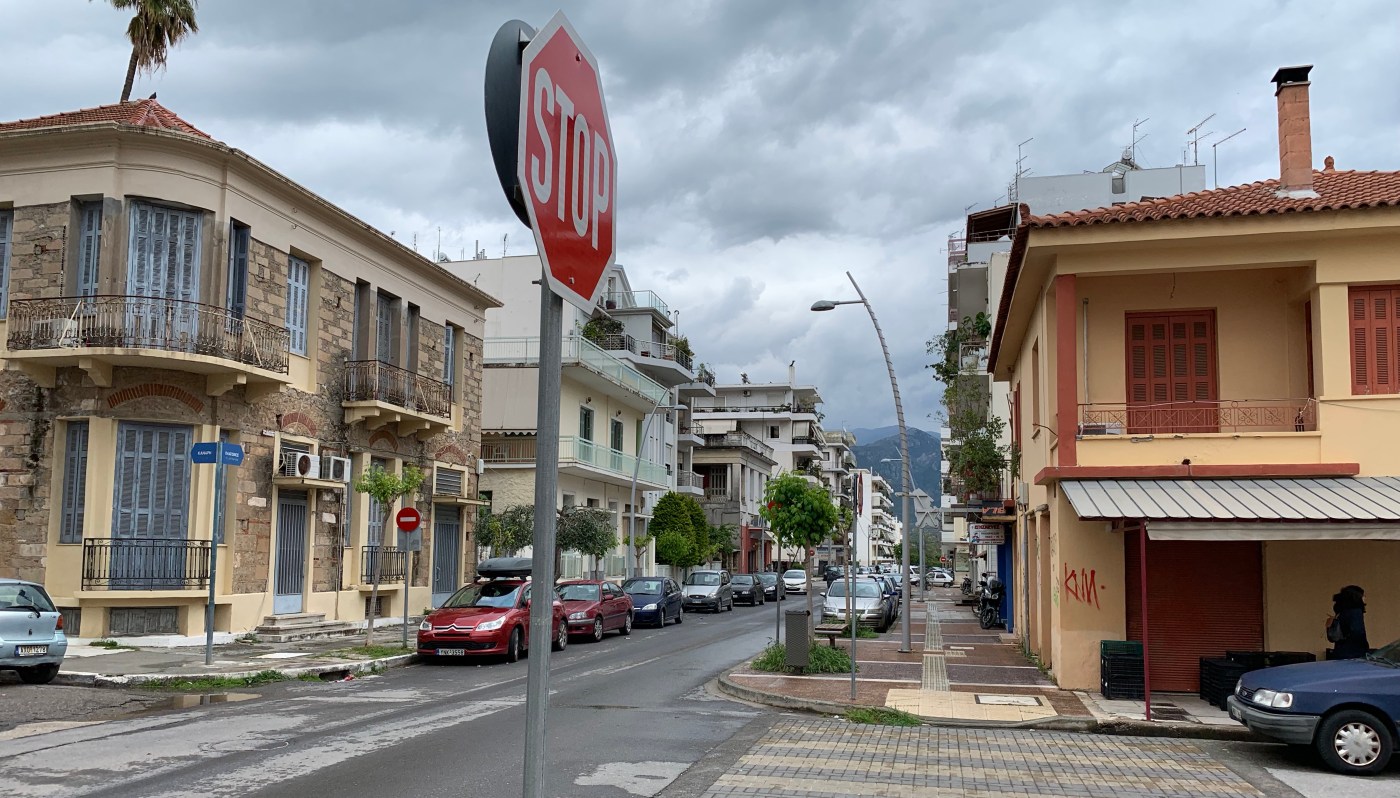
The mysteries of childhood can now be revisited through Google Earth and its many locational tools. Recently, transported by ‘Street View,’ I returned to Platonos (Plato) Street—the epicentre of my childhood games and wanderings. Back then, the name Plato meant nothing to me; yet now, it feels like a meaningful coincidence that the philosopher’s name framed Sophia’s world, my three-by-three block universe. This was where I first learned to point to things with their name, no matter how different they looked when they cast their long cool evening shadows on the parched walls than what they were in bright sunlight.
From that first satellite image, the town appeared scarcely larger than I had imagined; the world seemed to end—and still does—a short distance beyond my three-by-three block universe, near the corner of Platonos Street and Kanari. The digital grid stretched north to south in perfect lines. Then, with a click, Street View dropped me to the ground, and suddenly I was standing beside our house.
It still stands as I remember it, flanked by three houses on the left and another across the street—largely unchanged after all these years. Yet the patio where orange trees once grew has vanished, walled off by a shop that now occupies one side. Here I lived among whispers and lullabies, stories carried from distant worlds, conjured by my mother and grandmother through songs and winged words.
My father, a topographer, often traveled—mapping in my imagination vast, unknown territories: farmlands, swamps, rivers, Venetian castles, and rugged coastlines. On summer nights, he would carry me on his shoulders, and I marveled at the immense moonlit shadow we cast as we walked home from my aunt’s labyrinthine house.
Zooming in and out, I approached our house from both streets, absorbing every detail—the doorway, the verandas, the steps, the balcony railings, the shutters, the height of the pavement, the windows’ distance from the ground—all of it seeming to have shrunk over time. I measured my steps, tracing the space between our door and the shop entrance below, the spot where I once waited for the ice-cream man to wheel his tricycle through town. My memories now felt digitally ‘enhanced,’ an uncanny blend of Google Earth’s precision and the slippery recollections of childhood. In vain, I tried to glimpse the west-facing veranda, to see the world as I once saw it from that balcony—a theatre box overlooking a scenography of streets, courtyards, and gardens. It was a stage for hide-and-seek, for witches and wizards on broomsticks, for boys and tomboys kicking stones and scaling tall trees. The more fragments appeared, the more Google Earth became an accomplice to imagination. Memories surged back, yet never whole—missing the neighing of horses, the tang of stale wine, jars of olives, and the scent of ripe peaches and melons.
As a Google Earth flâneur, I wandered through half-remembered places that once filled my three-by-three block world or linked it to the territory beyond. The house with the fishpond remains intact, now home to a new generation of goldfish. My other aunt’s house still stands, though scarred by graffiti, its garden surrendered to weeds, its windows shattered—a silent testament to difficult times. Despite the clarity of its exterior, my memory of its interior remains fractured, broken into rooms and levels that refuse to connect. Some things will never align and we remain lost in their fragments. Yet, in my block-by-block travels, I discovered unexpected continuities. A straight route along Plato Street now leads from our house to the small white church. The hedge that once interrupted the street is gone; the road stretches through that pastoral-industrial land, bends around the church, then resumes its course to the sea. If I had drawn a straight line on a map back then, it would have linked our house to the church—a place that once seemed to hover in a nebulous ground.
‘A straight line from our house leads down to that church’ I told my father excitedly later that week. By then my father had lost entirely his sight in one eye and nearly half in the other. Though a topographer, he remained oblivious to the treasure trove revealed by Google Earth. Like me in childhood, he could no longer venture beyong three blocks, living – like an ancient ruin – largely in the shadows. Without surprise he replied: ‘Oh, I drew that plan. I was commissioned to lay it out, fill it with square blocks, price the plots, bend the street around the church and continue on the other side’. It was he who had mapped and divided that unfamiliar territory expanding what was once my three-by-three block world. He had inscribed coordinates locating this land within the larger world and linking it rationally to its neighbours.
Temporally, my recent discovery and his long-ago plan—drafted when nothing yet connected for me—were as distant as the church and our house once seemed. Whether labyrinthine or ordered by grids, the world now appeared to shrink back to Plato Street and our home, where a realm of mystery and imagination was being overlaid with the certainties of Cartesian knowledge.
My memories had been broken and patched and broken and patched again by a spatio-temporal cartography and geography beyond simple -comprehension. The only certainty I could salvage from my refashioned recollections was an image of the house – here it stands, a gate to the past, to infinite space-time, aligning and misaligning the geo-referenced mind.
 Con-figurations