
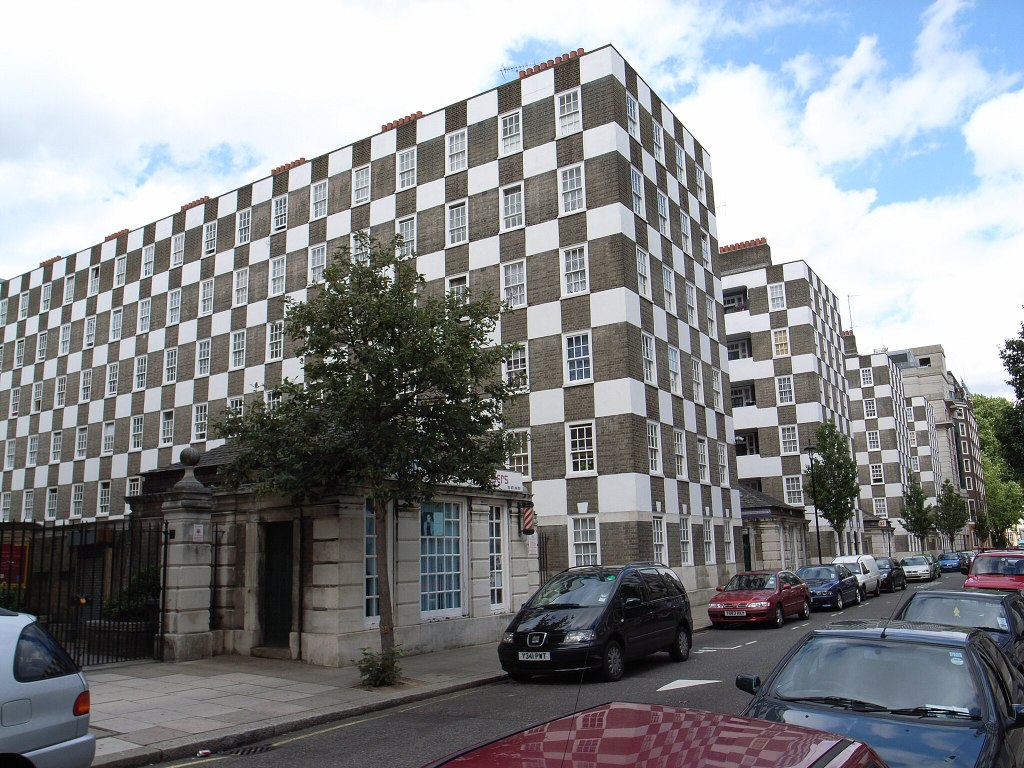
Page Street and Vincent Street Housing (1928-1930), by Edwin Lutyens. Image credits: Steve Cadman, Wikipedia Commons
As England embarks yet again on a major housing building programme in the first quarter of the 21st century under the New Towns Task Force , it is worthwhile reflecting on earlier architectural attempts to address previous acute housing shortages.
Many of these responses were based on radical new approaches imported from continental Europe. Le Corbusier’s revolutionary ideas about large scale housing and urban living provided the seeds for many British architects to cultivate their own distinctive British typologies for large scale housing. Some of these developments have been listed for preservation, others have been refurbished at great expense and still others have faced wholesale demolition.
The experience with large scale housing, built rapidly in the sixties and seventies with ideological rigidity, low budgets, experimental structural systems and cheap materials presented a momentary response. But avant-gardist designs that dissolved the dense urban fabric of the 19th century city, and a lack of on-going costly maintenance resulted in a backlash against such architectural experimentation. It led to a more chastened profession when the call came to advance solutions for large scale urban housing. For design practice and theory, the crucial question of how social purposes could be embodied in spatial form was never adequately pursued, and convincing answers were never found.
Faced with the current challenge of the major housing programme where should architects start in search of precedents? Not far from the Houses of Parliament in Westminster, a walk through Page Street and its surroundings provides a potted history of large scale social housing from the beginning of the 20th century.
Far from being reliant on continental European models, in the 1930s, Edward Lutyens, distinguished for his colonial buildings and individual houses designed his only social housing project. Commissioned by the land owners – the Grosvenor Estate – to provide housing ‘for the working classes’, the housing was then transferred to London County Council (1930–33). This development is one of the first social housing estates listed for preservation in the early 1970s.
Here Lutyens created a number of six storey orthogonal blocks with distinctive chequer board panels on the elevation. The blocks were arranged around a central courtyard with access to individual flats from open balconies. Although the use of multi storey open balcony access may seem innovative at the time, many social housing development from that period and before incorporated them into their design. Lutyens respected the building line set by Page Street and provided a small pavilion type building in classical style as an entrance gateway.
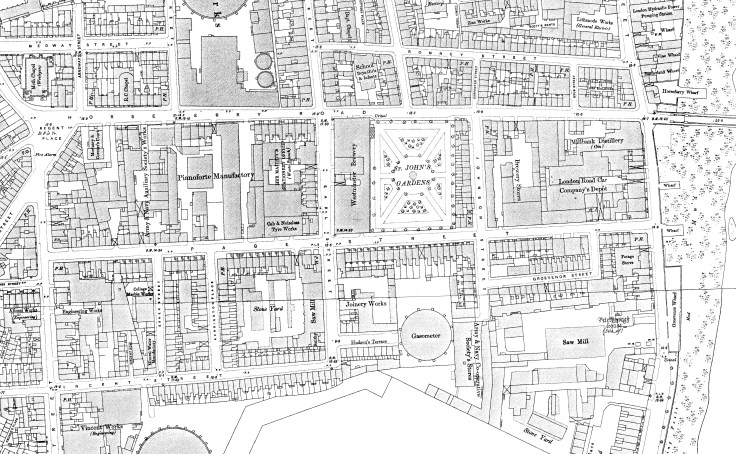
In doing so he was partly following the approach adopted by London County Council whose six storey brick buildings (1902) designed by Joseph & Smithem complete the block. This development has been providing social housing accommodation for more than a century. The form derived from private mansion block housing can be seen in many of the social housing projects commissioned by local authorities or the expanding charitable housing sector at the time.
Lutyens realised an exceptionally dense inner-city development of 604 flats in six-storey blocks, achieving almost twice the housing density of comparable schemes. In so doing he was responding in a way being advocated through various ‘densification’ policies and schemes advanced in our cities today.
The repetitive nature of mass housing is underscored by the uniform treatment of the façades, where alternating panels of brick and plaster form a highly distinctive checkerboard motif. This bold surface patterning contrasts with the refinement of the classical entrances expressed in a series of pavilion-like buildings set between the blocks. Contrary to their previous incarnation as – gate lodges to large private country estates – the function of this typology in Page Street was much more ordinary but essential, servicing residents with essential collective needs like shops and laundries.
Several main entrances along the street are marked by heraldic carvings and dramatic arches with broken entablatures crowned by small cenotaph-like forms. With recessed centres and projecting wings, they recall the façades of Elizabethan palaces. Given the eclectic styles adopted, were this building to be designed in the 1980s it could easily be regarded as exhibiting all the signifiers of post-modernism.
The U-shaped blocks open onto the street, setting up a dynamic contrast between entrance courts and garden courts, a design choice intended to allow the sunlight to get between them. With this early example of deck access in Britain, entered from central courtyards there is no doubt about the project’s modernist intent. Where the deck balconies meet the sash windows and break apart into the brick-and-cement grid of the façades, the effect is particularly striking in an abstract way.
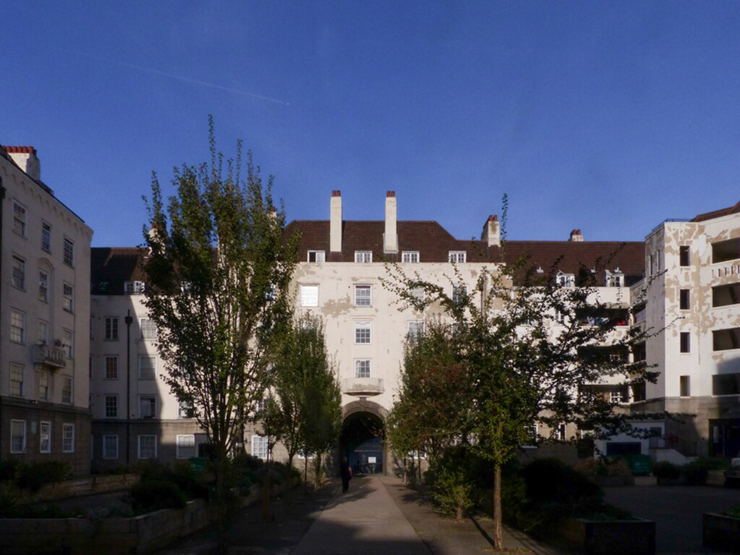
Lutyens’ housing project is perhaps one of the most sophisticated developments of the urban block typology that was widely used in London, Glasgow, Manchester and Liverpool as well as in continental Europe and North America at the turn of the 20th century and in the interwar period. Examples are the Millbank Estate in Westminster (1899-1902) designed by Reginald Milton Taylor, the Boundary Street Estate in Bethnal Green (1893-1900) designed by Owen Fleming, the Webber Row Estate in Southwark (1899-1907) by James and Stark, the Bourne Estate in Camden (1901-05) by Earnest Hadden Parkes and the Austrian housing inspired Ossulston Estate by G. Topham Forrest consisting of 514 dwellings on Chalton Street in Somers Town (where the Master of Architectural and Urban Historic Environments at the Bartlett UCL is currently undertaking its research and design projects).
Caught in a huge wave of urbanisation, London saw its two to four-storey neighbourhood changed into five to ten-storey developments. Public housing was organised by London County Council which embarked on large scale slum clearance, introducing the city block which preserved the traditional streets but introduced green spaces in the interior.

All of these provide different versions of approaches to meet the needs of social housing tenants at moderately high density. In principle the type of housing that would seem to meet the multifaceted requirements of what we now regard as sustainable development.
Not far away in Moreton Street is a more recent approach from Darnbourne and Darke architects (1967-1973) to address a similar challenge. Immediately recognisable where the housing bridges the public road, Lillington Gardens is a specimen of post WWII development, where fertile ground was offered for architectural experimentation, facilitated by the devastation of the Blitz and supported by the rise of socialist housing policies.
In my next blog I will interrogate more closely Lillington Gardens and other post- WWII modernist schemes to see what we can draw from the experience with such projects, and place them in a broader theoretical context.
 Con-figurations