

95 Peckham Road, London, Peter Barber Architects, 2019
This is the final post in my trilogy of blogs on social housing. Blog 1 explored a concentration of diverse social housing developments within a small part of London to see what lessons might help address today’s acute housing need. Blog 2 situated those initial observations within a broader architectural and urban context, examining large-scale social housing as a cultural and political project. Blog 3 now turns to the following questions:
How do we address acute housing shortages in the 21st century? What is the role of the architect?
Housing shortages are severe across the world. They affect both developed and developing countries, though for different structural and economic reasons. Who bears responsibility for these conditions? Who should put them right? What obligations fall to national and local governments—and where does architecture, with its multifaceted capacities, fit within this picture?
A good starting point lies in Article 25 of the UN Declaration of Human Rights, often invoked by policymakers and activists. It asserts the right to sufficient food, clothing, housing, and healthcare. Yet, as former UK Supreme Court judge Lord Sumption observed, such rights in a democracy ultimately depend on political choice. Otherwise, he argues, all social policy would be determined by the courts rather than through democratic deliberation. In his view, “housing for all is an admirable aspiration, no stronger than that.”
Social housing therefore, belongs firmly in the political realm, competing for attention alongside other pressing social priorities within increasingly constrained public budgets. In this political economy, the architect’s role might seem utilitarian: to house the greatest number of people to the highest standard within available resources. But is that a sufficient definition of good design? Can meaningful design principles be drawn from this? If not, what other parameters must inform quality housing design today?
Meeting projected housing demand in England will require building at a scale unseen since the 1960s, when substantial public investment in the New Towns programme and other initiatives drove a major expansion in housing supply.
Globally, responses vary. Some countries with rapidly expanding cities build ever higher, at super-densities. Others—especially those with rich urban legacies from the nineteenth century—pursue medium-density solutions. Britain falls into this latter category, seeking to regenerate post-industrial sites with more intensive residential use, optimising well-located land while fostering diverse and dynamic communities. Large-scale, medium-density housing is typically conceived at the block rather than the individual site scale, influencing both its local setting and the wider city. It also encourages collective rather than individual provision of services.
Within this framework, architects play a critical yet expanded role—one that goes well beyond the conventional boundaries of the profession. Many already engage as urban designers and masterplanners, working across scales to integrate multiple systems and interests. Designing at block scale demands precisely the integrative thinking that architectural training provides, but also a shift of focus—from the design of buildings to the governance of complex, multi-stakeholder processes.
Such work is time-consuming but essential. It is how we create the preconditions for social cohesion as new developments mature. European precedents offer valuable lessons. Vienna, for instance, is often celebrated for its communitaire approach to municipal housing—but can its success be replicated elsewhere, or are its social and political conditions too particular?
In the early 20th century, society was far more acquiescent. While we may now admire Lutyens’ Page Street scheme, it is unlikely that much effort was made to engage future residents or understand their needs. Social housing then often functioned as a mechanism of social order, a spatial tool to regulate a rapidly growing population. The term “no fixed abode” captured the anxiety surrounding those outside this order.
Today, before any major development begins, a crucial question arises: Where is the ‘community’ to be found? In an age when community has lost much of its spatial coherence—fragmented by digital and virtual networks—can we still speak meaningfully of spatial contiguity, physical proximity, or the classic sociological notion of Gemeinschaft?
While we await more comprehensive answers from the social sciences, we can tentatively propose several parameters—emerging from the earlier blogs—for designing large-scale, medium-density social housing in the 21st century.
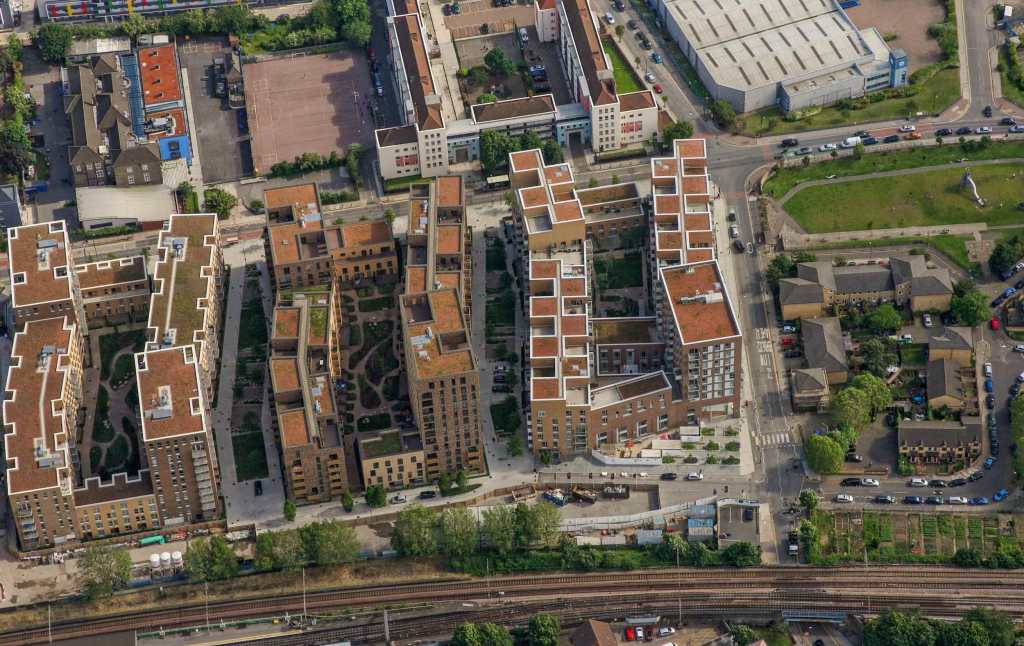
St Andrew’s apartment complex Bromley-by-Bow, London, Architects: Allies and Morrison, 2012.
Parameters for Designing Large-Scale, Medium-Density Social Housing
When designing with these challenges in mind one should consider the following dimensions:
Equity and Inclusion
- Accessibility and inclusion by all ages, abilities, ethnic and racial backgrounds.
- Equitable distribution of resources, schools, shops, green spaces, work, leisure, and transport.
- Recognising housing and public space as fundamental rights rather than privileges.
- Avoid displacement that disproportionally disadvantages low-income residents.
- Bottom-up vision and meaningful participation of local communities in design and planning process, so that decisions reflect lived experiences, and residents participate as co-designers or co-managers.
- Environmental justice addressing inequalities to pollution, noise, flooding or lack of green space.
- Diversity in design, embodying diverse identities, histories, memories and traditions.
- Invest in governance, stable structures for financing maintenance, management and long-termoperation of the buildings, the spaces around the buildings and community services on the site.
Adaptability, long term value and sustainability
- Changing household formation
- changing economic pressures
- New lifestyles
- New technologies
- New environmental demands
- Allowing retrofitting for energy efficiency and resilience.
Diverse and equitable economic models
Consider both current (housing associations) and alternative economic models that decouple housing from pure real estate speculation:
- Cooperative and collective ownership (Mehr als Wohnen, Zurich, Baugruppen, Germany). Community land trusts, community investment and bonds (CLT St Clemens, London; Granby 4 Streets, Liverpool).
- Pension fund or cooperative bank investment.
- Self-built & incremental models (Quinta Monroy Housing, Elemental Chile, Alejandro Aravena).
- Non-profit housing development (Naked House London).
Innovation
Innovation is what makes many of these models viable and socially valuable. It is essneital to reassert the need for innovation as an essential part of the design process.
- Mixed-tenure layouts, blending affordable and market-rate homes without visible distinction.
- Shared community infrastructure of high quality (kitchens, laundry, workshops, gardens…).
- Climate responsive design.
- Co-housing clusters.
- Flexible interior to be designed by residents.
- Open-ended grids: infrastructure laid out for gradual infill providing the structural frame, services and roof with residents completing the rest (e.g. Elemental, Quinta Monroy, Chile by Alejandro Aravena).
- Inspiration from history: re-imagining past models not to copy or revive a form but to extract a social, economic, environmental, spatial logic and translate it into new forms and technologies of today.
 Con-figurations